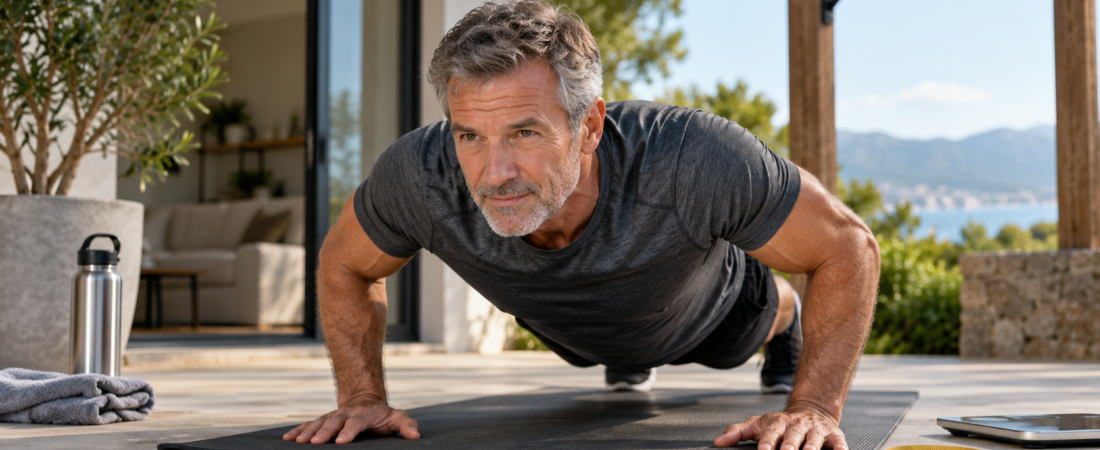
After years of trying to stay lighter, I gained about 8 kg on purpose. The goal was not size. It was to build a body that could keep working for decades.
For much of my 40s, I thought being lighter was a good thing.
At 44, I started kickboxing.
I trained seriously, ate less, often kept lunch very small, and eventually dropped into the 50-kilogram range.
My waist became smaller. My clothes became looser. I stayed at that lower weight for almost three years.
At the time, I saw this as success.
Then my thinking began to change.
About six months before I moved to Cambodia, I strained a muscle in my leg while training at a kickboxing gym.
It was not a catastrophic injury.
But it forced me to think differently.
I was still fit.
My cardiovascular endurance was good.
I could train hard.
But fitness in one dimension did not necessarily mean that my entire body was equally prepared for repeated high-intensity stress.
That injury became one of several reasons I began asking a different question.
Not:
How light can I become?
But:
What kind of body do I want to have at 60, 70, and beyond?
I Began Thinking About Muscle Differently
My research had already pushed me in this direction.
I have studied sarcopenia and body composition in surgical patients, including patients with lung cancer.
Over time, I became increasingly interested not only in how much muscle people have, but also in muscle quality.
More recently, I have been studying myosteatosis—the infiltration of fat within and around skeletal muscle—and its possible relationships with metabolism, inflammation, and clinical outcomes.
Research made me more cautious about treating body weight as a simple health score.
A lower number on the scale can mean less fat.
But it can also mean less muscle.
And two people with similar weight or BMI may have very different body composition, strength, and metabolic health.
At 50, I no longer wanted to optimize for being light.
I wanted to optimize for function.
So I Intentionally Gained Weight
Over roughly the past year, I intentionally gained about 8 kg.
That may sound strange in a culture where weight loss is usually presented as the default goal after middle age.
But my goal was not simply to become bigger.
I wanted to gain weight while watching what happened to:
- strength
- waist circumference
- aerobic fitness
- recovery
- sleep
- training consistency
- overall physical function
If my weight increased while my strength improved and my waist remained reasonably controlled, I considered that very different from simply gaining weight without paying attention to body composition or performance.
The scale became only one measurement.
Not the target.
I Did It With Bodyweight Training
I did not build this approach around heavy gym lifting.
Most of my strength training has been bodyweight-based.
Push-ups.
Pull-ups.
Squats.
Different angles.
Slower repetitions.
Greater range of motion.
More difficult variations.
Higher repetition when appropriate.
What surprised me was how much training stimulus can be created without constantly adding heavier external loads.
By changing leverage, tempo, range of motion, and exercise difficulty, bodyweight training can become demanding.
For me, this had an additional attraction.
I could create a meaningful training stimulus without constantly chasing heavier and heavier loads.
That mattered more after the injury I had experienced in my late 40s.
My goal is not to test the maximum load my body can tolerate.
My goal is to expose the body to enough stress to adapt—while still being able to train again tomorrow, next week, and next year.
That is a different philosophy.
Enough Stress to Adapt. Not So Much That You Break
This is one of the biggest changes in how I think about exercise after 50.
When we are younger, it is easy to think that more intensity is automatically better.
More weight.
More speed.
More volume.
More pain.
But the real question is whether the training can be repeated consistently.
A workout that produces an impressive number but leaves you injured for several weeks may not be a good long-term trade.
At this stage of life, I care more about the relationship between stimulus and recovery.
Can the exercise make me stronger?
Can I recover?
Can I keep training?
Can I still work effectively?
Can I maintain mobility and aerobic capacity at the same time?
That is what matters to me.
Bodyweight Training Is Not Automatically Easy
There is another misconception I had to reconsider.
Bodyweight training is sometimes treated as beginner training.
It does not have to be.
A standard push-up may become easy.
But elevate the feet.
Slow the lowering phase.
Pause at the bottom.
Increase range of motion.
Shift more load toward one side.
The same principle applies to squats, pull-ups, and many other movements.
The body itself can become the resistance.
The challenge is learning how to manipulate that resistance.
This does not mean bodyweight training is always safer, or that injuries cannot happen.
Technique, progression, fatigue, and individual limitations still matter.
But for me, it has become a practical way to create substantial training stress without making external load the central objective.
I Am Not Trying to Become a Bodybuilder
My goal at 50 is not maximum muscle size.
It is also not maximum strength.
I want muscle that remains useful.
Muscle that helps me move.
Muscle that supports metabolic health.
Muscle that allows me to work, travel, operate, train, and take on new challenges.
I still care about aerobic fitness.
I still care about waist circumference.
I still care about sleep and recovery.
Strength is one part of the system.
The body has to work as a whole.
What I Am Really Trying to Build
At 44, I was trying to lose weight.
At 50, I am asking what that weight is made of.
That shift may be more important than the 8 kg itself.
I am no longer trying to become as light as possible.
I am trying to build a body that remains strong, mobile, resilient, and useful.
And I am trying to do it in a way I can continue for years.
At 50, I am not training for my 50s.
I am training for my 70s.
The number on the scale matters.
But what matters more is what that body can still do.
And whether it will still be able to do it decades from now.