What sarcopenia research taught me about training for the decades ahead
When people begin strength training in their 40s or 50s, the natural tendency is to focus on the muscles that are easy to see and easy to measure. Chest, shoulders, arms, and legs respond visibly to training, and gym machines make it possible to load each of them in a controlled way. There is nothing wrong with this approach. Resistance training remains one of the most important things we can do to preserve physical function with age.
But my own interest has gradually shifted toward a different question: how well does the body work as a connected system?
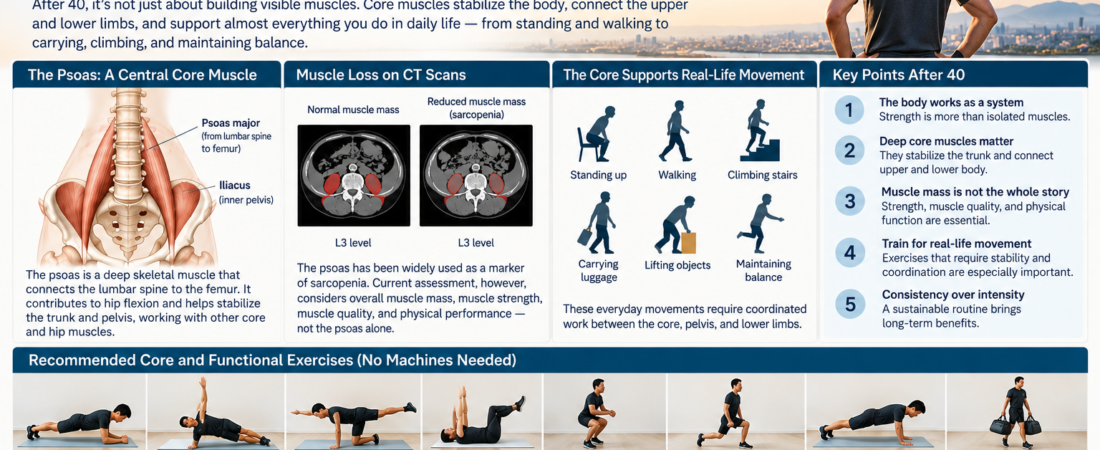
Part of that change came from my research on sarcopenia in patients with lung cancer. In several studies, we measured the psoas muscle on CT scans as an indicator of skeletal muscle loss. Patients with reduced muscle mass, particularly those who developed sarcopenia after surgery, tended to have worse long-term outcomes.
The psoas is not a special “longevity muscle,” and it should not be treated as one. It is simply one skeletal muscle among many. Historically, however, it was convenient to measure on routine CT scans, and this made it useful as a marker of muscle depletion.
More recently, the field has moved away from relying too heavily on a single muscle or a single cross-sectional area. Modern sarcopenia assessment places greater emphasis on muscle strength, total muscle quantity or quality, and physical performance. When CT is available, the total skeletal muscle area around the L3 level is generally more representative of whole-body muscle mass than the psoas alone.
I think this evolution in sarcopenia research contains an important lesson for training after 40.
The question is not simply how much muscle we have, but how well that muscle allows us to move.
The psoas is interesting in this context because of where it sits and what it does. It connects the lumbar spine and pelvis with the femur and contributes to hip flexion and stabilization during movement. Together with the abdominal wall, spinal muscles, gluteal muscles, and other structures around the pelvis, it forms part of the system that allows force to pass efficiently between the upper and lower body.
This matters because most activities in daily life are not isolated movements. Standing from a chair, climbing stairs, carrying luggage, lifting something from the floor, walking on uneven ground, or recovering balance all require several regions of the body to work together. The trunk is not merely something that sits between the arms and legs. It is the structure through which much of that movement is coordinated.
For this reason, I would not argue that people over 40 should stop using resistance machines. Machines are useful, particularly because they allow specific muscles to be trained safely and progressively. They may be especially helpful for beginners, people recovering from injury, or those who need controlled loading.
The limitation is simply that the machine often provides part of the stability for you. In daily life, the path of movement is not fixed. The body must generate force while simultaneously controlling posture, balance, and the position of the pelvis and trunk.
That is why I think training after 40 should include movements that ask the body to stabilize itself.
Traditional core exercises such as the plank, side plank, bird dog, and dead bug can be useful, but I do not think core training should stop there. Squats, split squats, loaded carries, push-ups, rows, and similar whole-body movements also require the trunk to control and transmit force. In practical terms, they teach the body to remain stable while the arms and legs are working.
This is closer to what we actually need outside the gym.
The broader lesson from sarcopenia research is also relevant here. Two people can have similar muscle mass on an image yet have very different levels of strength and physical function. Preserving muscle quantity is important, but preserving the ability to use that muscle is at least as important.
For me, this has changed the way I think about exercise in my 50s. I still want to maintain muscle and strength, but I am less interested in training individual muscles in isolation than I once was. I want strength that transfers into standing, walking, carrying, swimming, running, climbing, and reacting when balance is disturbed.
That is ultimately why I place more value on trunk strength and whole-body training as I get older. The purpose is not to build a stronger “core” as a separate body part. It is to preserve the ability of the entire body to work together.
After 40, that may matter more than how any single muscle looks in the mirror.
Build whole-body strength into your plan after 50
The After 50 Body Code Blueprint helps you put strength training into a structured 8–12 week plan alongside cardio, nutrition, and recovery. Use your Body Code to choose your starting priority and adjust your training to your current level.