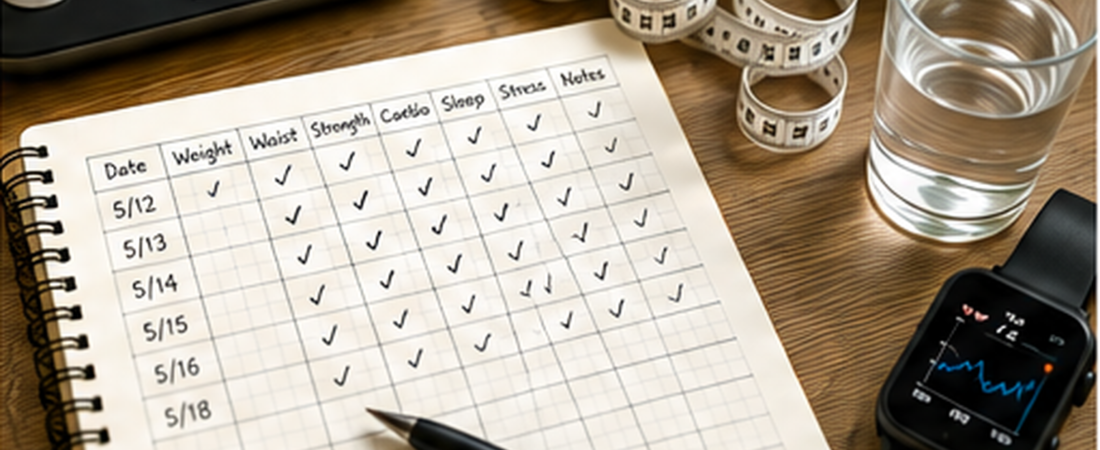
At 50, I do not want to judge my health from one number.
Body weight matters, but it is only one part of the picture.
What interests me more is the direction of change:
Am I getting stronger?
Is my waist increasing or decreasing?
Am I maintaining aerobic fitness?
Am I sleeping well?
Am I recovering?
Can I still work, train, and move the way I want to?
I do not track my body to control every number.
I track it so I can see the direction.
Over the next decade, I want to follow a small set of measurements consistently and learn how they move together.
1. Body Weight — Useful, but Never Alone
Body weight is easy to measure, which makes it useful.
But a single number tells me very little by itself.
My weight can change because of fat, muscle, glycogen, water, food intake, or even the time of day.
So I am less interested in one measurement than in the trend over weeks and months.
I also interpret body weight together with other information.
If my weight increases while my waist stays stable and my strength improves, that means something very different from gaining weight while my waist expands and my physical performance declines.
The same is true in the opposite direction.
Losing weight is not automatically progress if strength and muscle are disappearing with it.
Body weight is a signal. It is not the diagnosis.
2. Waist Circumference — A Simple Number With Useful Context
Waist circumference gives me information that body weight alone cannot.
It is a simple way to follow changes in abdominal size over time, and it can provide useful context when my body weight changes.
For example, if my weight increases but my waist remains stable while my strength improves, I interpret that very differently from weight gain accompanied by a steadily increasing waist.
I do not treat waist circumference as a perfect measure of visceral fat, and I do not expect small week-to-week changes to mean very much.
What matters more is the longer-term trend.
Weight tells me how heavy I am. Waist circumference gives me another clue about what may be changing underneath.
3. Strength — What My Body Can Actually Do
Strength is one of the most practical indicators I can follow.
It tells me something body weight cannot:
what my body can actually do.
I do not need complicated equipment to track it. I can use repeatable movements such as pull-ups, push-ups, squats, or other exercises that I perform under similar conditions.
I am not trying to maximize one-repetition strength.
What matters to me is whether my strength is being maintained, improving, or gradually declining over time.
A heavier body with better strength may represent progress.
A lighter body with clearly worse strength may not.
That is why strength has become one of the numbers I trust most when I evaluate my own direction after 50.
4. Aerobic Fitness — Can I Still Sustain Effort?
Aerobic fitness matters because strength alone is not enough.
I want to know whether I can still sustain effort, recover from it, and continue moving efficiently.
I do not need to perform a formal cardiopulmonary exercise test every week. Simple, repeatable indicators are enough for regular tracking.
These might include resting heart rate, walking or running pace, how long I can sustain a given level of exercise, or how quickly I recover afterward.
What matters is consistency.
If the same activity gradually feels harder, or recovery becomes slower, that may be worth paying attention to.
If I can maintain or improve aerobic capacity while also preserving strength, that is a much more meaningful picture of health than body weight alone.
After 50, I want both: strength to move well and endurance to keep going.
5. Sleep and Recovery — What Happens Between Workouts
Sleep and recovery are easy to underestimate because they are less visible than body weight or strength.
But they influence almost everything else I am trying to preserve.
Poor sleep can affect training quality, recovery, appetite, mood, concentration, and how hard the same exercise feels.
So I pay attention not only to how long I sleep, but also to whether I wake feeling recovered and whether my performance is changing over time.
I do not expect every night to be perfect.
What matters more is the pattern.
If poor sleep continues for days or weeks, and at the same time my strength, motivation, or physical condition declines, that tells me something.
Training creates the stimulus. Recovery determines what I can do with it.
6. Stress and Mental Condition — The Invisible Load
Stress is another load on the body, even when it does not look like exercise.
Work pressure, travel, poor sleep, uncertainty, and emotional strain can all influence how I feel and how well I recover.
I do not try to reduce stress to zero. That is unrealistic.
Instead, I pay attention to whether stress is becoming persistent, whether it is affecting sleep or training, and whether my physical condition or motivation is beginning to decline.
For long-term tracking, even a simple self-rating can be useful if I record it consistently.
The goal is not to turn every feeling into data.
It is to notice when the invisible load becomes large enough to change the direction of everything else.
The body does not separate physical stress from mental stress as neatly as we often do.
7. Consistency — The Metric Behind All the Others
Consistency may be the most important metric of all.
One strong workout, one good night of sleep, or one perfect week of eating tells me very little.
What matters is whether I can keep doing the basics over months and years.
I want to know:
Am I still training regularly?
Am I still sleeping reasonably well?
Am I still eating in a way that supports strength and metabolic health?
Am I still making time for recovery?
Consistency is what connects all the other measurements.
It is also what makes long-term data meaningful.
A single number can fluctuate. A repeated pattern tells a story.
What I Want These Numbers to Tell Me at 60
By the time I reach 60, I do not expect these numbers to tell me exactly how to stop aging.
That is not the goal.
What I want is a decade of consistent information that helps me understand my own trajectory.
Did my strength remain stable?
Did my waist gradually increase or decrease?
Did periods of poor sleep or high stress coincide with declines in performance?
Did changes in training or nutrition produce changes that lasted?
And perhaps most importantly:
Was I still able to work, move, recover, and take on meaningful challenges the way I wanted to?
I am not interested in chasing perfect numbers.
I am interested in preserving function.
At 50, that is how I now think about health:
not as a single measurement, but as a direction of travel.
Ten years from now, I want to be able to look back and see not only what changed, but what may have helped shape that change.
This article is part of my Doctor After 50 project — a long-term exploration of strength, muscle quality, body composition, and healthy aging.