Living longer is not the same as staying strong enough to use those years.
When I turned 50, I began thinking about time differently.
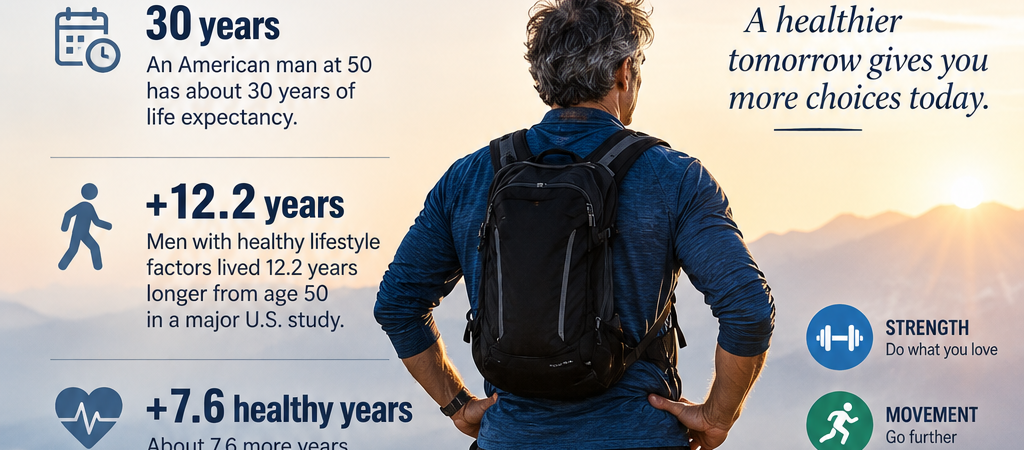
According to U.S. life-table data, an American man who reaches age 50 has roughly another 30 years of life expectancy. Thirty years is not a short period. It is enough time to begin another career, learn something completely new, move to another country, build a business, or pursue work that once seemed unrealistic.
But life expectancy raises another question that interests me more as a physician.
How many of those years will we remain healthy enough to use well?
Living to 80 and being physically capable at 80 are not the same outcome.
The Difference Between Living Longer and Living Well
We usually talk about longevity as though reaching a certain age were the objective. I increasingly think that this is incomplete.
I want to know whether, at 70 or 80, I can still walk long distances, get off the floor easily, carry luggage, travel, exercise, work, recover from illness, and continue doing difficult things.
I think of these as our usable years. It is not a medical term. It simply describes the part of life during which our health and physical capacity still allow us to do the things that matter to us.
As a surgeon, I have cared for many people whose health changed suddenly. Before serious illness, health often existed quietly in the background. Once illness appeared, the body could become the central condition around which work, family, travel, and almost every other decision had to be reorganized.
That experience has made it difficult for me to assume that good health will simply continue.
Lifestyle Is Associated With a Remarkably Large Difference
A major U.S. study using participants from the Nurses’ Health Study and Health Professionals Follow-Up Study examined five low-risk lifestyle factors: never smoking, regular physical activity, healthier diet quality, a normal BMI, and moderate alcohol intake as defined by the investigators.
For men at age 50, estimated remaining life expectancy was 25.5 years among those with none of the five low-risk factors and 37.6 years among those with all five.
The difference was 12.2 years.
This does not mean that following five rules will automatically add twelve years to an individual life. The study was observational, and people who maintain healthier lifestyles differ in many ways that cannot be completely separated statistically. I would also not interpret the alcohol component as a reason for a non-drinker to begin drinking.
The important message is simpler: what we repeatedly do in middle age is strongly associated with how long we live.
A later analysis from the same large U.S. cohorts looked not simply at survival, but at life expectancy free from cancer, cardiovascular disease, and type 2 diabetes.
Among men at age 50, those with four or five low-risk lifestyle factors were estimated to have approximately 7.6 additional years free of these major chronic diseases compared with men who had none.
To me, this distinction is important. The goal is not merely to accumulate years. It is to preserve as many years as possible in which disease has not yet taken control of our choices.
Why Muscle Became Part of This Question for Me
My interest in healthy aging did not begin as a fitness project. It developed partly through my work as a thoracic surgeon and researcher.
My colleagues and I have studied sarcopenia and body composition in patients undergoing surgery for lung cancer. Those studies repeatedly brought me back to one problem: body weight alone tells us surprisingly little about muscle and physical reserve.
Two people can have similar BMI values while having very different muscle status and physical function. More recently, I have also become interested in myosteatosis and the possible relationships between muscle quality, metabolism, inflammation, and clinical outcomes.
This does not mean that findings from cancer patients can simply be applied to healthy adults. They cannot. But this research changed the questions I ask about my own body.
I no longer want to know only whether I am lighter.
I want to know whether I am stronger, aerobically fit, recovering well, and maintaining a body that will remain useful as I age.
My Own Goal Changed in My 40s
At 44, I began training seriously in kickboxing and lost considerable weight. For several years I remained in the 50-kilogram range. My waist became smaller, and I initially regarded that lower weight as clear progress.
About six months before moving to Cambodia, however, I sustained a muscle strain while training at a kickboxing gym. I was cardiovascularly fit and capable of training hard, but the injury reminded me that fitness in one dimension does not mean that every component of the body is equally prepared for physical stress.
My goal gradually changed.
Over the past year, I have intentionally gained approximately eight kilograms. I am not trying to become as large as possible. I am watching what happens to my strength, waist circumference, aerobic capacity, sleep, recovery, and general physical function as my weight changes.
Most of my strength work is bodyweight-based, using movements such as push-ups, pull-ups, squats, and rows. By changing leverage, tempo, range of motion, and difficulty, I can create substantial resistance without making heavier external loads the main objective.
The purpose is not maximum strength. It is sustainable strength.
After 50, Strength and Aerobic Fitness Both Matter
Current U.S. physical activity guidance recommends at least 150 minutes of moderate-intensity aerobic activity each week, or 75 minutes of vigorous activity or an equivalent combination, together with muscle-strengthening activity on at least two days per week.
I think the combination matters.
Cardiovascular fitness without attention to muscle is incomplete. Strength without aerobic capacity is also incomplete. After 50, I want enough of both to preserve function.
This does not mean everyone needs to become an athlete. A useful body may mean different things to different people. One person may need to reduce abdominal fat while protecting muscle. Another may have a normal BMI but poor strength and need to build rather than lose weight. Someone else may already have a good physical foundation and simply want to preserve it for the next twenty years.
There is no single ideal body after 50.
There is, however, a useful question:
Is your body moving in the direction you want it to go?
Health Is Not the Background of Life
We often organize our lives around career, money, family, travel, and ambition while assuming that the body will continue carrying us through all of it.
Until it cannot.
That is why I no longer think of training primarily as a cosmetic activity.
For me, maintaining strength and fitness means preserving the ability to operate, research, travel, work, learn, and continue taking on challenges. Someone else may want the capacity to play with grandchildren, hike with a partner, continue running a company, or simply remain independent.
The specific goal is personal. The underlying principle is not.
The body is the infrastructure that allows us to use our time.
At 50, I may have roughly thirty years ahead. I have no way of knowing how many I will actually receive.
What I can do is take reasonable care of the body I have now.
Healthy behavior cannot guarantee longevity. Exercise cannot guarantee that we will avoid cancer or cardiovascular disease. Strength cannot stop aging.
But we are not powerless either.
The evidence suggests that the choices repeated over years are associated not only with how long people live, but with how many of those years may remain free from major chronic disease.
For me, that is enough reason to act.
Taking care of the body we have today is not vanity. It is one way of showing gratitude for the time we still have.
References
Li Y, et al. Impact of Healthy Lifestyle Factors on Life Expectancies in the US Population. Circulation. 2018.
Li Y, et al. Healthy lifestyle and life expectancy free of cancer, cardiovascular disease, and type 2 diabetes. BMJ. 2020;368:l6669.
National Center for Health Statistics. United States Life Tables, 2023.
CDC. Physical Activity Guidelines for Adults.
Not Sure What to Work on First After 50?
Your weight or BMI alone cannot tell you what your body needs next. Take the free After 50 Body Assessment to see your Body Code, four-domain score, priority area, and first pathway.
Take the Free Body Assessment →https://doctorafter50.com/body-assessment/