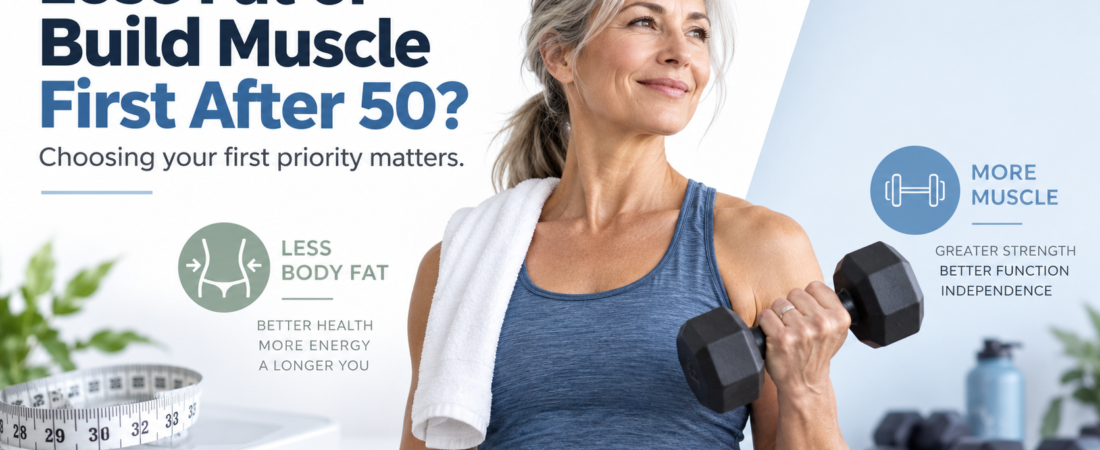
After 50, one of the most common fitness questions sounds simple:
Should you lose fat or build muscle first after 50? The starting point is understanding what needs attention: excess body fat, reduced strength, or both. This guide explains how to look beyond body weight and choose a starting priority that fits your current condition.
The problem is that these are not always opposite goals.
And for many people, choosing one based only on body weight may send them in the wrong direction.
A better question is:
What does my body need first?
That depends not only on how much you weigh, but also on your waist, strength, physical activity, recovery, and what you want your body to be able to do ten or twenty years from now.
Why Weight Alone Does Not Answer the Question
For much of my 40s, I thought being lighter was generally better.
I trained hard, kept my food intake low, and eventually became quite lean.
But as I became more interested in sarcopenia, body composition, and muscle quality, my thinking changed.
Weight loss can mean losing fat.
But it can also mean losing muscle.
Likewise, gaining weight can mean gaining excess fat.
But it can also occur while strength and muscle are improving.
This is why I no longer think the scale can tell us whether someone should lose weight or gain muscle.
We need more information.
Situation 1: Your Waist Is High, but Your Strength Is Reasonably Good
This is often a body-composition problem rather than simply a weight problem.
The goal may be to reduce excess fat while preserving as much muscle and strength as possible.
I think of this as recomposition.
The target is not:
“Make the number on the scale fall as quickly as possible.”
It is closer to:
Waist down. Strength maintained or improved. Physical capacity preserved.
This distinction becomes increasingly important with age because aggressive weight loss without attention to muscle can move two things in the wrong direction at the same time: fat decreases, but muscle may decrease as well.
Research in older adults with overweight or obesity supports combining weight-loss strategies with resistance exercise when preservation of lean mass is important.
So if your waist is clearly moving in the wrong direction, you may need to lose fat.
But that does not mean muscle should be ignored until later.
Situation 2: Your Weight Looks Fine, but You Are Weak
This is the opposite problem.
You may have a normal BMI.
You may even look relatively lean.
But if getting out of a chair is becoming harder, push-ups are difficult, you rarely challenge your muscles, and your physical reserve is shrinking, losing more weight may not be the best first goal.
This is one reason I have become increasingly interested in muscle quality.
A lean-looking body is not automatically a strong body.
And a normal number on the scale does not tell us how much functional reserve we are carrying into our 60s and 70s.
In this situation, I would think much more about building a physical foundation.
The first objective may be to become stronger, train consistently, and improve the body’s ability to tolerate exercise.
Only then does it make sense to worry about becoming leaner.
Situation 3: Your Waist Is High and Your Strength Is Low
This is probably the situation where the simple question — “fat loss or muscle gain?” — is least useful.
You may need both.
But trying to pursue both aggressively at the same time can make the plan unnecessarily complicated.
I prefer to think in phases.
First, build enough strength and exercise capacity to train consistently.
At the same time, begin improving body composition without extreme dieting.
Once that foundation improves, the next phase can become more specific.
This is what I call a Foundation First or Two-Phase approach.
The important point is sequencing.
Your final goal may be substantial fat loss, more muscle, better athletic performance, or all three.
But your first 8–12 weeks do not have to solve everything.
They only need to move you in the right direction.
Situation 4: Your Waist Is Controlled and Your Strength Is Good
Then you may not need a “weight problem” at all.
This is where many health discussions after 50 become too narrow.
Not everyone needs to lose weight.
And not everyone needs to maximize muscle size.
If your body composition is reasonably good and you already have a solid strength foundation, the next target may be performance.
Can you improve aerobic fitness?
Can you move better?
Can you recover better?
Can you remain strong while improving endurance?
Can you keep doing physically demanding things as you age?
For me, that is a much more interesting goal than simply trying to become lighter.
Do Not Forget the Engine
There is another reason the fat-versus-muscle question can be misleading.
It ignores aerobic fitness.
Strength matters.
Muscle matters.
Body composition matters.
But so does the ability to keep moving.
Current physical activity guidelines recommend that adults combine aerobic activity with regular muscle-strengthening exercise rather than treating one as a replacement for the other.
That makes sense to me.
I do not want to build a body that is strong for thirty seconds but unable to sustain effort.
Nor do I want excellent endurance with too little strength to tolerate physical stress.
After 50, I think we need both an engine and a chassis.
Recovery Can Change the Answer
There is one more factor people often ignore.
Recovery.
If you are sleeping poorly, chronically fatigued, under heavy stress, or repeatedly getting injured, the answer may not be “lose more fat” or “build more muscle.”
The first priority may simply be creating enough recovery capacity to train consistently.
More exercise is not always better.
More dieting is not always better.
Sometimes the body needs a period in which the goal is not maximum progress.
The goal is to become trainable again.
The Real Question After 50
So should you lose fat or build muscle first?
There is no universal answer.
If your waist is high but strength is good, improving body composition may come first.
If your weight is normal but strength is poor, building muscle and function may matter more.
If both body composition and strength need work, you may need a phased approach.
And if both are already reasonably good, your next target may be fitness, performance, or long-term function rather than body weight.
This is why I built the After 50 Body Assessment.
It looks at four areas together:
Body & Waist. Strength & Function. Engine & Activity. Recovery & Load.
It then combines those results with what you actually want your body to do next.
The purpose is not to give you one permanent label.
It is to help answer a more useful question:
What should I work on first?
Find Your Starting Point
If you are not sure whether your next phase should focus on fat loss, muscle, fitness, or recovery, take the free After 50 Body Assessment.
You will receive your Body Code, your lowest-scoring domain, and a suggested first pathway for the next 8–12 weeks.
Take the Free After 50 Body Assessment →
After 50, the goal is not simply to weigh less.
It is to build a body that can keep doing what you want it to do.
Ready to turn this into an 8–12 week plan?
The After 50 Body Code Blueprint helps you choose your starting priority and structure your strength training, cardio, nutrition, and recovery around your Body Code. Explore the 77-page guide and see what’s included.