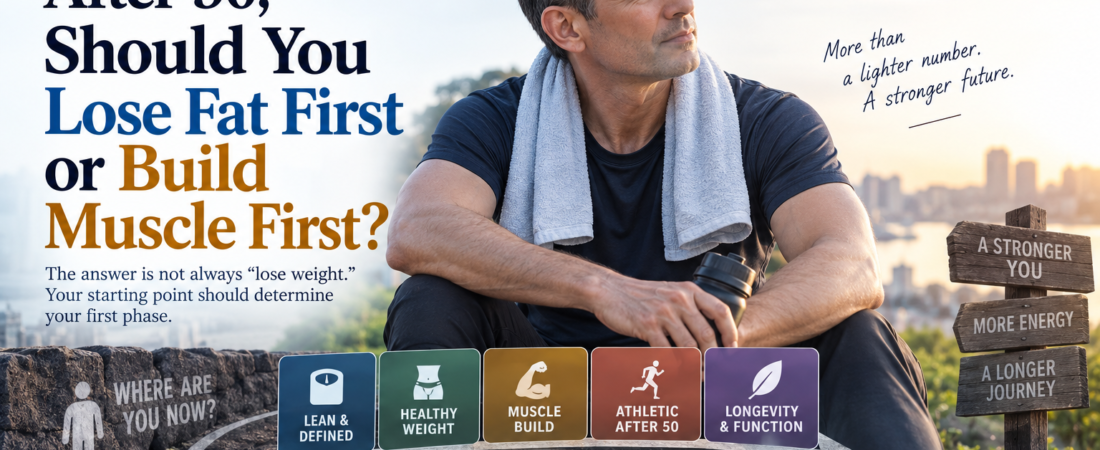
The answer is not always “lose weight.” Your starting point should determine your first phase.
For years, the default advice in middle age has been simple:
If you are heavier than you want to be, lose weight.
If you want to look stronger, build muscle.
But after 50, I think that question needs to be more precise.
What is your body made of now—and what are you trying to build next?
A person with excess abdominal fat and low strength does not have the same starting point as someone who is lean but losing muscle.
A person with a normal BMI but poor strength does not need the same plan as someone with obesity who wants an athletic body.
And someone who is already fit may not need a “weight-loss phase” at all.
That is why I increasingly think in phases, rather than simply in kilograms.
I Used to Think Lighter Was Better
In my mid-40s, I started kickboxing and lost a substantial amount of weight.
I became leaner. My waist became smaller. I stayed in the 50-kilogram range for several years.
At the time, I viewed the lower number on the scale as evidence that I was moving in the right direction.
My thinking changed gradually.
Part of that came from my own research into sarcopenia and body composition.
Part came from clinical experience.
And part came from my own body.
About six months before moving to Cambodia, I sustained a muscle strain while training at a kickboxing gym.
I was fit. My cardiovascular endurance was good. But that did not mean every part of my body was equally prepared for repeated physical stress.
Eventually I stopped asking:
How light should I be?
and started asking:
What kind of body do I want to carry into my 60s and 70s?
Three Different Starting Paths
I now think there are at least three useful ways to approach body change after 50.
These are not medical diagnoses or validated clinical categories. They are a practical way of thinking about the relationship between your starting point and your goal.
1. Build Directly
Some people do not need to lose fat first.
Their waist is reasonably controlled. Their body weight is not the main problem. But they may want more strength, more muscle, or better physical capacity.
For them, the first phase may simply be:
Build strength while maintaining aerobic fitness and body composition.
This is close to what I am doing now.
Over the past year, I intentionally gained about 8 kg.
I did not want maximum size.
I wanted a stronger body while continuing to watch my waist, aerobic capacity, recovery, and function.
The scale went up.
That was intentional.
2. Recompose
Another person may carry more body fat than they would like, but may not need an aggressive weight-loss phase.
Instead, the goal may be:
reduce fat while preserving—or improving—strength.
That is body recomposition.
This is important because weight loss alone can also reduce lean tissue.
A 2025 systematic review and meta-analysis of 25 randomized trials in adults with overweight or obesity found that adding resistance exercise during dietary weight loss helped attenuate loss of fat-free mass, increased fat loss, and improved strength compared with diet-only weight loss.
That changes the question.
The goal is not simply:
How much weight did I lose?
It becomes:
What did I lose, what did I preserve, and what can my body do now?
For many people after 50, that is a much more useful question.
3. Use a Two-Phase Approach
For someone with substantial excess body fat or central adiposity who ultimately wants a lean, muscular, or athletic body, I think a two-phase model often makes more practical sense.
Phase 1
Reduce excess fat while protecting muscle and building basic fitness.
Phase 2
Shift the emphasis toward building the desired body and performance.
The key point is this:
Phase 1 is not “diet first, exercise later.”
Strength work should already be part of the first phase when it is safe and appropriate.
Aerobic activity matters too. WHO recommends adults accumulate 150–300 minutes of moderate-intensity aerobic activity per week, or 75–150 minutes of vigorous activity, together with muscle-strengthening work involving major muscle groups on at least two days per week.
So even during fat reduction, the body is still being trained.
You are not waiting to become lighter before becoming stronger.
What About Someone Who Is Already Thin?
This may be the group that receives the least useful advice.
If your BMI is normal—or even low—but your strength is poor, losing more weight may be exactly the wrong target.
A normal BMI does not tell us whether you have adequate muscle.
It does not tell us whether you can perform repeated chair stands.
It does not tell us whether you can do a push-up.
It does not tell us how much aerobic work you can sustain.
And it certainly does not tell us everything about muscle quality.
Research in older adults increasingly reinforces the importance of looking beyond total body mass. Reviews of resistance training in older adults have emphasized body composition, strength, and physical function rather than weight alone.
That is also consistent with what my own research into sarcopenia has taught me:
body weight is information—but it is not the whole body.
The Goal Changes the Path
Imagine three people.
One wants to reach a healthy weight.
One wants to build muscle.
One wants to remain athletic and capable into their 70s.
They should not automatically receive the same plan.
That is why I am developing the After 50 Body Assessment.
The idea is simple.
First, identify your current foundation across four areas:
Body & Waist
Strength & Function
Engine & Activity
Recovery & Load
Then choose where you want to go:
Lean & Defined
Healthy Weight
Muscle Build
Athletic After 50
Longevity & Function
Only then should you decide whether your first step is:
Direct Build
Recomposition
Foundation First
or a Two-Phase Path
Because the best program is not necessarily the hardest one.
It is the one that matches the body you actually have today.
After 50, Do Not Automatically Choose Weight Loss
If excess fat is an important problem, reducing it can absolutely matter.
But I would not want to sacrifice muscle and function simply to produce a smaller number on the scale.
If you are thin but weak, your goal may be to build.
If you have moderate excess fat and reasonable function, recomposition may make sense.
If you have substantial excess fat and an ambitious physical goal, your journey may require two phases.
And if you already have a good foundation, you may be ready to build directly.
At 44, I was trying to become lighter.
At 50, I am trying to build something more useful.
A body that is strong enough to work.
Fit enough to keep going.
And resilient enough to carry me into the decades ahead.
The question after 50 is not simply:
Should I lose weight or build muscle?
It is:
Where am I now, where do I want to go—and what should my first phase be?