After 50 Body Assessment
This free assessment looks at four parts of your current physical foundation: Body & Waist, Strength & Function, Engine & Activity, and Recovery & Load.
At the end, you will receive your starting class, your selected body goal, and a practical pathway for what to focus on first.
Designed by Yoshihisa Shimada, MD, PhD. This is an educational wellness tool and is not a medical diagnosis or individualized treatment plan.
Before You Start: Quick Safety Check
Please answer all five questions before continuing.
1. Do you experience chest pain or pressure during physical activity?
2. Have you had unexplained fainting, near-fainting, or severe dizziness?
3. Do you have unusual shortness of breath during light activity?
4. Do you currently have a significant muscle, joint, or bone injury, or have you recently had major surgery?
5. Has a healthcare professional told you to avoid or restrict exercise?
Body & Waist
Start with a few basic measurements. Weight alone does not tell the whole story, so we will also calculate your BMI and waist-to-height ratio.
Stand relaxed, breathe normally, and place the tape horizontally around your waist. Do not pull the tape tightly or hold your breath.
These measurements are screening and planning tools. BMI does not directly measure body fat or muscle mass.
How Strong Is Your Current Foundation?
These tests are not about maximum performance. They give us simple, repeatable markers of lower-body function and upper-body strength.
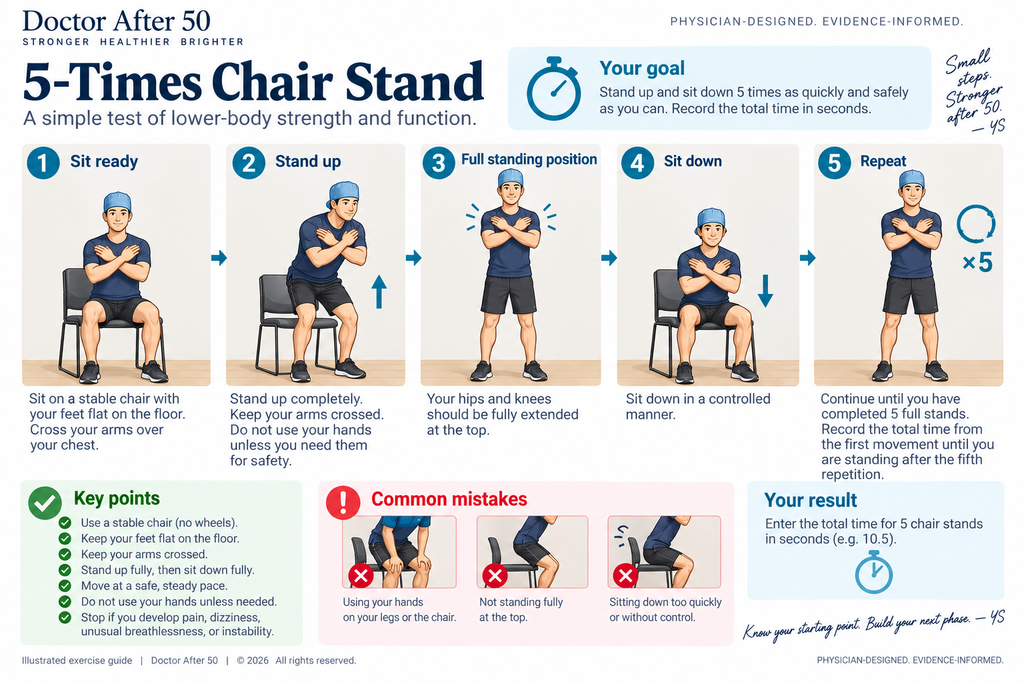
Test 1 — 5-Times Chair Stand
How to perform it:
- Sit on a stable chair with your feet flat on the floor.
- Cross your arms over your chest.
- Stand up completely, then sit down again.
- Repeat until you have completed 5 full stands.
- Record the total time from the first movement until you are standing after the fifth repetition.
Do not use your hands unless you need them for safety. Stop if you develop pain, dizziness, unusual breathlessness, or instability.
seconds
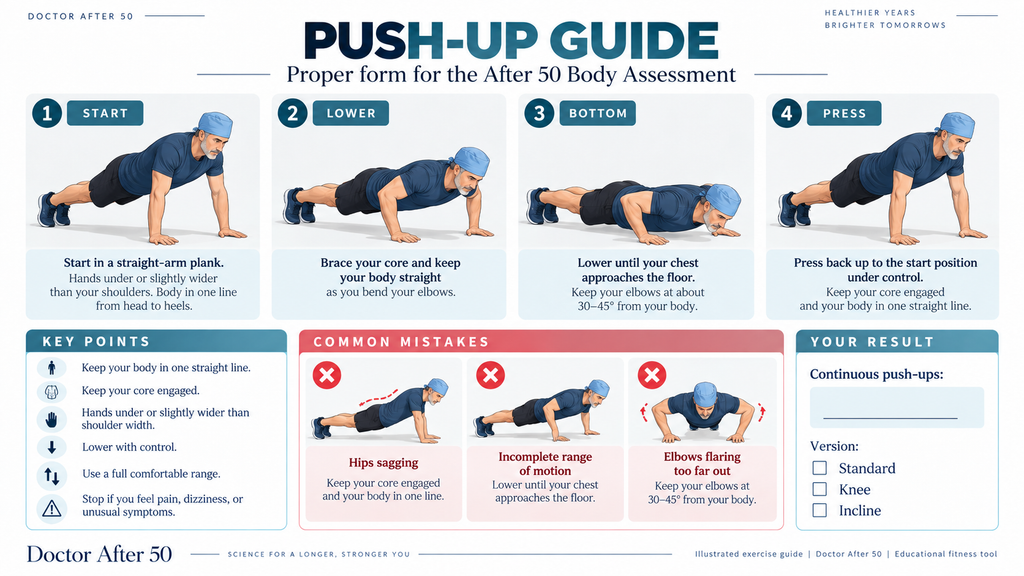
Test 2 — Push-Ups
Count only repetitions completed with consistent form.
- Keep the trunk controlled rather than allowing the hips to sag.
- Lower under control.
- Return to the starting position with full control.
- Stop counting when you can no longer maintain the same technique.
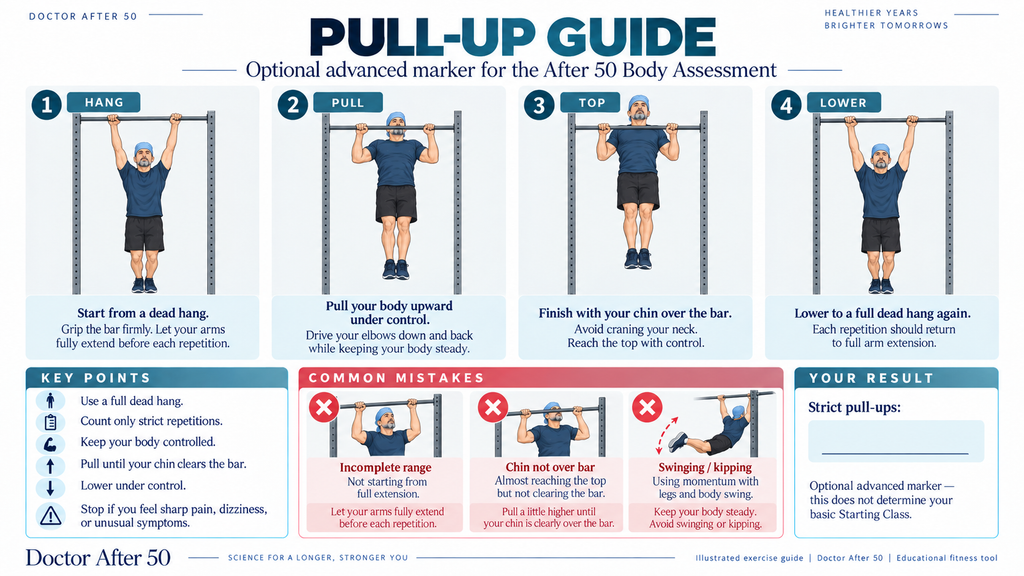
Optional Advanced Marker — Pull-Ups
Pull-ups are not required for this assessment and do not affect your Starting Class.
If you have access to a secure pull-up bar and can perform the movement safely, record the number of strict repetitions you can complete. If you do not have access to a pull-up bar, simply skip this test.
You can repeat this optional test later at a gym or any location with a secure bar.
How Well Can You Keep Going — and Recover?
Strength is only one part of physical capacity. This section looks at your weekly aerobic activity, sleep, recovery, and current stress load.
Aerobic Activity
Estimate a typical week. Do not count the same activity twice.
Moderate: brisk walking, steady cycling, easy swimming —
breathing is faster but conversation is still possible.
Vigorous: running, hard cycling, fast swimming, intense sport —
speaking more than a few words becomes difficult.
Sleep
Recovery / Readiness
How ready does your body usually feel for normal activity or your next workout?
Current Stress Load
How much does stress currently affect your sleep, concentration, recovery, or everyday life?
What Do You Want Your Body to Do Next?
There is no single ideal body after 50. Choose the goal that best matches what you want to build over the next phase of your life.
Put the Whole Picture Together
Your result combines your current body measurements, strength, aerobic activity, recovery, and selected goal.
Body & Waist — 25 points
Strength & Function — 25 points
Engine & Activity — 25 points
Recovery & Load — 25 points
Total: 100 points
What to Do With Your Result
After You Get Your Body Code: Open Your 8–12 Week Guide
Your Body Code is not just a label. It is designed to help you decide what to focus on first.
Use two parts of your result:
Your Path tells you the overall strategy.
Your lowest-scoring domain tells you where you currently have the greatest room to improve.
You do not need to fix everything at once. Choose the right first phase, work on it consistently for 8–12 weeks, and then reassess.
1. Follow Your Path
Direct
You already have enough of a physical foundation to begin working directly toward your selected goal.
For the next 8–12 weeks, keep resistance training and aerobic activity consistent while progressing toward your goal. Do not judge progress from body weight alone. Watch strength, waist circumference, fitness, sleep, and recovery together.
Recompose
Your first goal is not simply to lose weight. It is to improve body composition while preserving or increasing strength.
Use regular resistance training as the foundation, combine it with consistent aerobic activity, and track waist circumference together with strength. A lower number on the scale is not useful if strength and function are also declining.
Foundation First
Your first phase should be about building the capacity to train consistently.
Start with manageable resistance exercise, regular walking or other tolerable aerobic activity, and good movement quality. The goal is not maximum effort. The goal is to create a foundation that can support more demanding training later.
Two-Phase
Trying to pursue your final goal immediately may not be the best first step.
For the first 8–12 weeks, focus on improving waist and body composition while protecting muscle and maintaining physical activity. Then repeat the assessment. If your foundation has improved, move into the second phase toward your selected muscle, athletic, or body-composition goal.
2. Work on Your Lowest-Scoring Domain
If Body & Waist Is Lowest
Do not focus on body weight alone.
Track your waist circumference, body weight, and strength together. The aim is to improve body composition without sacrificing muscle or physical function.
A useful direction is:
Waist down or stable + strength stable or improving = generally favorable progress.
If Strength & Function Is Lowest
Make resistance training your main physical priority.
Use your 5-Times Chair Stand and Push-Up results as repeatable markers. You do not need to test them every workout. Train consistently and repeat the tests after several weeks under the same conditions.
Your goal is not simply to perform more repetitions. It is to become stronger while maintaining good movement quality.
If Engine & Activity Is Lowest
Build your aerobic base gradually.
For most adults, a practical target is to work toward approximately 150–300 minutes of moderate-intensity aerobic activity per week, or an equivalent combination of moderate and vigorous activity.
Walking, cycling, swimming, jogging, and similar activities can all contribute.
The goal is not exhaustion. It is to build the ability to sustain effort and recover from it.
If Recovery & Load Is Lowest
More training is not automatically better.
Pay attention to sleep duration and quality, persistent fatigue, stress, soreness, motivation, and your ability to recover between sessions.
If recovery is deteriorating while training volume keeps increasing, adding more exercise may move you in the wrong direction.
Treat recovery as part of the program, not as time away from the program.
3. A Simple 8–12 Week Framework
For most people, the first phase can be built around three things:
Resistance training: approximately 2–4 sessions per week depending on your current level and goal.
Aerobic activity: gradually work toward approximately 150–300 moderate-equivalent minutes per week if appropriate for your current capacity.
Recovery: protect sleep and avoid increasing training volume simply because you had one good week.
Your exact exercise selection, sets, repetitions, progression, and nutrition depend on your starting point. The purpose of this free assessment is to help you decide which direction deserves attention first.
4. Track Direction, Not Perfection
During the next 8–12 weeks, keep a simple record of:
Body & Waist: body weight and waist circumference
Strength & Function: Chair Stand and Push-Up performance
Engine & Activity: weekly aerobic activity
Recovery & Load: sleep, recovery, and stress
You do not need perfect data.
You need enough data to answer one question:
Is my body moving in the direction I want it to go?
5. Reassess After 8–12 Weeks
Repeat the After 50 Body Assessment under similar conditions.
Compare:
Body & Waist
Strength & Function
Engine & Activity
Recovery & Load
Your total score may change. Your weakest domain may change. Your Body Code may also change.
That is the point.
The goal is not to receive one permanent label at age 50.
The goal is to measure → act → reassess → redesign.
If your initial Safety Check included any “Yes” response, do not use this assessment as a reason to increase exercise intensity until the relevant issue has been appropriately evaluated. This tool is for education and planning and is not a medical diagnosis or individualized treatment plan.
77-page physician-designed guide · Instant PDF access · One-time payment