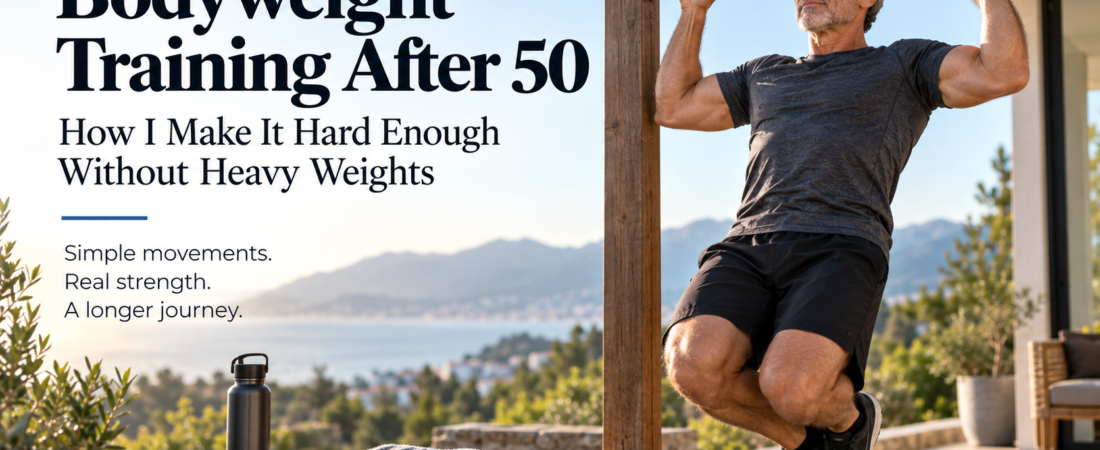
I train almost entirely with my own body weight. After 50, I have found that the challenge is not finding heavier weights. It is learning how to make simple movements difficult enough to keep adapting.
For many people, strength training means adding weight.
More plates.
Heavier dumbbells.
A bigger number on the machine.
I used to think in a similar way.
But after years of kickboxing, an injury in my late 40s, and my own research into aging muscle, I became more interested in a different question:
How much training stimulus can I create without constantly increasing external load?
At 50, most of my strength training is bodyweight-based.
Push-ups.
Pull-ups.
Squats.
Rows.
Different variations of the same basic movements.
And what I have learned is simple:
Bodyweight training is only easy if you keep doing the easiest version.
1. Change the Leverage
The easiest way to make a bodyweight exercise harder is to change the position of your body.
A normal push-up may become easy.
So I can elevate my feet.
Move my hands.
Shift more weight toward one arm.
Change the angle.
The exercise still looks like a push-up.
But the mechanical demand changes substantially.
The same principle applies to pulling movements and leg exercises.
You do not always need more kilograms.
Sometimes you simply need worse leverage.
2. Slow the Movement Down
Speed changes difficulty.
Ten fast repetitions and ten slow repetitions are not the same exercise.
I sometimes slow the lowering phase of a push-up or squat.
Three seconds down.
Pause.
Then return.
Suddenly, an exercise that felt easy becomes much harder.
Slowing the movement also forces me to pay attention to control rather than momentum.
For my current goals, that matters.
I am not trying to move the greatest possible load once.
I am trying to create a repeatable stimulus that I can recover from.
3. Use More Range of Motion
Another way to increase the challenge is to make the movement larger.
A shallow repetition may allow a high number of repetitions.
But increasing range of motion can change the demand completely.
This is one reason I do not judge a workout simply by the number of repetitions.
Twenty controlled repetitions through a demanding range may tell me more than fifty easy ones.
The number is only meaningful when the movement is defined.
4. Move Toward Harder Variations
Bodyweight exercises have progressions.
Push-ups can progress from easier versions to standard push-ups, feet-elevated push-ups, slower repetitions, pike-style movements, and asymmetrical variations.
Pulling can progress from rows to pull-ups and more demanding variations.
Squats can become slower, deeper, paused, or increasingly single-leg dominant.
This gives me another way to progress without making external weight the main variable.
The important word is progression.
Doing the exact same easy exercise forever is unlikely to create the same stimulus.
But bodyweight training does not have to remain the same.
5. Repetitions Still Matter
I also use volume.
For example, I may accumulate many push-ups across several variations rather than perform one maximum-effort set.
With pull-ups, I can monitor whether my repeatable number is improving.
With squats, I can change tempo, depth, or volume.
The goal is not to win a repetition contest.
The goal is to see whether my body is adapting.
Am I stronger than six months ago?
Can I perform the same movement with better control?
Can I do a harder variation?
Can I recover and repeat the training consistently?
Those questions matter more to me than the absolute number.
6. Pull-Ups Tell Me Something the Scale Cannot
I intentionally gained about 8 kg approaching age 50.
That makes some bodyweight exercises harder, not easier.
A pull-up is a good example.
If I become heavier but can still perform more pull-ups than before, that tells me something useful.
The scale only tells me that my body weighs more.
The pull-up tells me what that heavier body can do.
That is why I increasingly think in terms of function plus body composition, rather than body weight alone.
7. I Do Not Train to Failure Every Time
After 50, I care about tomorrow’s training too.
If every workout destroys my ability to train for several days, the workout may have been difficult—but that does not necessarily make it useful.
My experience with a muscle strain in my late 40s changed my thinking here.
I became more interested in finding the point where the stimulus is enough to produce adaptation without creating unnecessary damage.
That does not mean training gently.
Some sessions are hard.
But I no longer think that exhaustion itself is proof of a good workout.
The goal is adaptation, not punishment.
8. Strength Is Only One Part of the System
I do not train strength in isolation.
I also pay attention to:
- waist circumference
- aerobic fitness
- sleep
- recovery
- nutrition
- stress
- consistency
If strength improves but my aerobic fitness collapses, I would not consider that an ideal outcome.
If my weight increases rapidly and my waist expands at the same time, I would want to understand why.
If training volume rises but sleep and recovery deteriorate, that matters too.
At 50, I am increasingly interested in the whole system.
What I Want From Training at 70
I am not trying to prove that bodyweight training is superior to weight training.
Heavy resistance training can be extremely effective.
My point is different.
You can create substantial resistance without constantly chasing heavier external loads.
For me, bodyweight training has become a practical way to combine strength, mobility, control, and long-term consistency.
I want to be able to perform pull-ups at 60.
And, if possible, at 70.
I want to get off the floor easily.
Carry my own body.
Travel.
Work.
Operate.
Train.
And continue taking on difficult things.
That is the standard I care about.
At 50, I am not asking:
How much can I lift today?
I am asking:
What kind of training gives me the best chance of still being strong decades from now?
For now, bodyweight training is a major part of my answer.