For many years, we have judged health largely by what we can see.
Is someone overweight? Is the waist getting smaller? Is the number on the scale going down?
But there is another layer that is much harder to see.
Muscle quality.
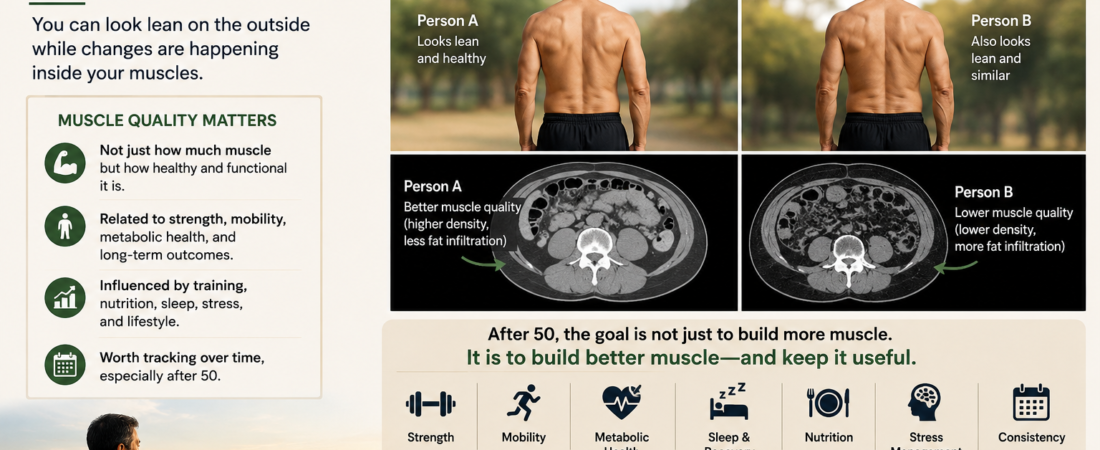
A person can look lean, have a relatively normal BMI, and still have changes within skeletal muscle that may matter for physical function and metabolic health.
This is one reason I became interested in myosteatosis — fat infiltration within skeletal muscle.
At 50, I no longer think only about how much muscle I have.
I also ask:
What kind of muscle am I carrying into the next decades of my life?
What Is Myosteatosis?
Myosteatosis is the accumulation of fat within and around skeletal muscle.
It is not the same as simply having more body fat.
Two people can have a similar body weight, a similar BMI, and even a similar amount of muscle, while the quality of that muscle is very different.
On CT, muscle with more fat infiltration has lower attenuation. Clinically, this matters because myosteatosis has been associated in many studies with poorer physical function, metabolic abnormalities, surgical complications, and worse outcomes in several disease populations.
That does not mean myosteatosis itself causes all of those problems. It may also be a marker of aging, inactivity, metabolic dysfunction, inflammation, or underlying disease.
But it tells us something important:
muscle quantity and muscle quality are not the same thing.
After 50, simply asking “Do I have enough muscle?” may therefore be too simple.
A better question may be:
How healthy and functional is the muscle I have?
Why Looking Lean Can Be Misleading
Looking lean can be reassuring, but appearance does not tell us everything about what is happening inside the body.
This became especially interesting to me after moving to Cambodia.
In routine health examinations, I began noticing that some relatively young and lean people still had mild dyslipidemia. At the same time, I was becoming increasingly interested in body composition and muscle quality.
That led me to a research question:
Could someone appear lean on the outside and still have poor muscle quality or an unfavorable metabolic profile on the inside?
This is one of the questions I am currently studying.
I do not yet want to overstate the answer. The research is ongoing.
But the question itself is important, because it challenges a very common assumption:
lean does not automatically mean metabolically healthy.
Body weight, BMI, waist circumference, muscle mass, muscle quality, physical function, and metabolic health are related — but they are not interchangeable.
What Muscle Quality Changes About the Way I Train
Thinking about muscle quality has changed the way I train.
I am not trying to become as light as possible, and I am not trying to build the largest muscles possible.
My goal is to maintain a body that is strong, mobile, metabolically healthy, and capable of working for decades.
That means I pay attention to more than body weight.
I look at strength, waist circumference, aerobic fitness, training consistency, food quality, protein intake, sleep, recovery, and stress.
I also try to avoid large swings in body weight that may reduce muscle along with fat.
I cannot directly measure my muscle quality every week. But I can influence many of the factors that may help preserve healthy muscle over time.
For me, the goal after 50 is not simply:
Build more muscle.
It is:
Build better muscle — and keep it useful.
What I Want to Know by 60
I have started thinking about the next decade as a long-term experiment.
From 50 to 60, I want to follow changes in my body consistently rather than relying on occasional measurements.
I plan to track simple things over time: body weight, waist circumference, blood pressure, strength, exercise, sleep, alcohol intake, physical condition, and mental condition.
I will also keep a regular photographic record.
This will not prove what works for everyone. It is an N-of-1 journey.
But after ten years, I may be able to look back and ask better questions:
When did my strength change?
What happened during periods of poor sleep or high stress?
Did changes in weight or waist circumference occur alongside changes in physical performance?
And as methods improve, could future AI help identify patterns that I cannot see today?
I do not know what the answers will be.
That is exactly why I want to record the journey.
At 50, I am not trying to stop aging. I am trying to understand it well enough to influence the trajectory.
This article is part of my Doctor After 50 project — a long-term exploration of strength, muscle quality, body composition, and healthy aging.
Not Sure What to Work on First After 50?
Your weight or BMI alone cannot tell you what your body needs next. Take the free After 50 Body Assessment to see your Body Code, four-domain score, priority area, and first pathway.
Take the Free Body Assessment →https://doctorafter50.com/body-assessment/