In 2020, at the age of 44, I started kickboxing.
At the time, I was slightly overweight. Like many people trying to become healthier, my first goal was simple: lose weight.
I changed the way I ate. For a period, lunch was extremely light — sometimes nothing, sometimes only a piece of bread — and I essentially lived on two main meals a day.
It worked, at least by the usual measures.
My weight fell into the 50-kilogram range. The fat around my waist clearly decreased. My clothing size changed substantially, and I maintained that lower weight for almost three years.
If I had judged my health only by body weight and appearance, I might have considered the experiment a success.
But several years later, I began asking a very different question:
What if being lighter does not necessarily mean having a healthier body underneath?
What Changed When I Moved to Cambodia
When I moved to Cambodia at 48, I started eating lunch regularly again.
At the hospital, I could usually choose between Khmer food and Japanese food. One difference became obvious to me: the amount of oil used in the meals.
Around that time, for the first time in my life, my lipid profile became slightly abnormal.
I cannot say that one type of food caused that change. But it made me pay closer attention to what I was eating and to the metabolic health of the people around me.
During routine health examinations at the hospital, I also noticed something that interested me: even some relatively young and lean Cambodian people had mild dyslipidemia.
That observation raised a question.
Can a person look lean on the outside and still have poor muscle quality or an unfavorable metabolic profile on the inside?
That question eventually led me toward myosteatosis — fat infiltration within skeletal muscle — and to the possibility that muscle quality might be related to metabolic disease, lifestyle, and long-term health outcomes.
I began studying it.
Why Myosteatosis Changed the Question
Myosteatosis changed the way I thought about body composition.
Until then, it was easy to think in simple categories: lose fat, preserve muscle, keep body weight under control.
But muscle quality is more complicated than that.
Myosteatosis refers to fat infiltration within skeletal muscle. It can be present even when someone does not appear obese, and it has been associated in research with poorer physical function, metabolic abnormalities, and worse outcomes in several clinical populations.
That made me increasingly interested in a different question:
What if the important issue after 50 is not simply how much muscle we have, but what kind of muscle we have?
In Cambodia, that question became especially relevant to me. I began studying whether people who appear lean could still have poor muscle quality, and whether that might be related to dyslipidemia, lifestyle factors, or other health outcomes.
The work is still ongoing, so I do not want to overstate the conclusions.
But the question itself changed the way I think about aging.
A lean body is not necessarily a healthy body.
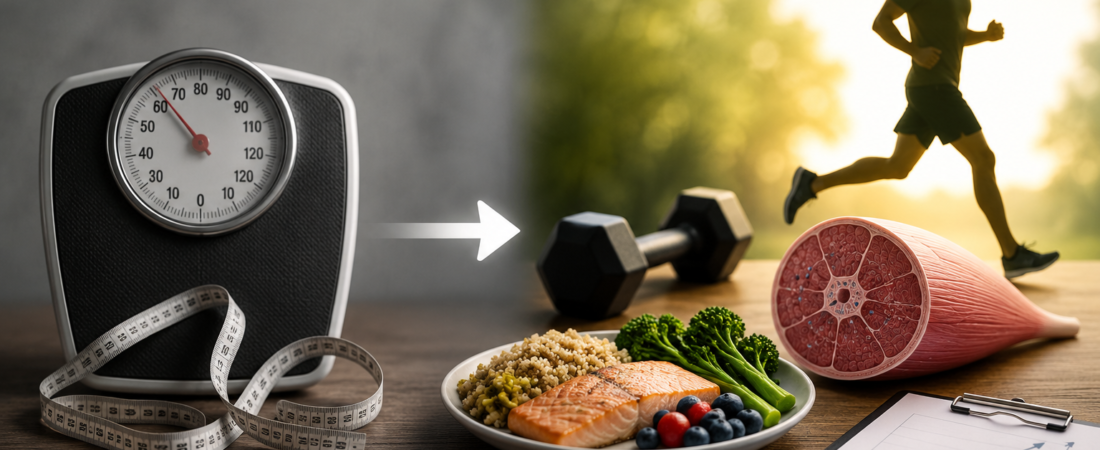
From Weight Loss to Body Design
By the time I reached 50, my goal had changed.
I was no longer trying to make the number on the scale as low as possible.
I wanted to build a body that could remain strong, mobile, metabolically healthy, and capable of supporting work and challenge for decades.
That meant paying attention not only to body weight, but also to strength, waist circumference, aerobic fitness, food quality, sleep, recovery, and stress.
In some ways, my BMI became less important even as it increased.
What mattered more was whether I was improving the composition and function of the body behind that number.
At 44, I was trying to lose weight.
At 50, I am trying to understand what that weight is made of — and what kind of body I want to carry into the decades ahead.
That is the shift I now think matters most after 50:
from weight loss to body design.
This article is part of my Doctor After 50 project — a long-term exploration of strength, muscle quality, body composition, and healthy aging.