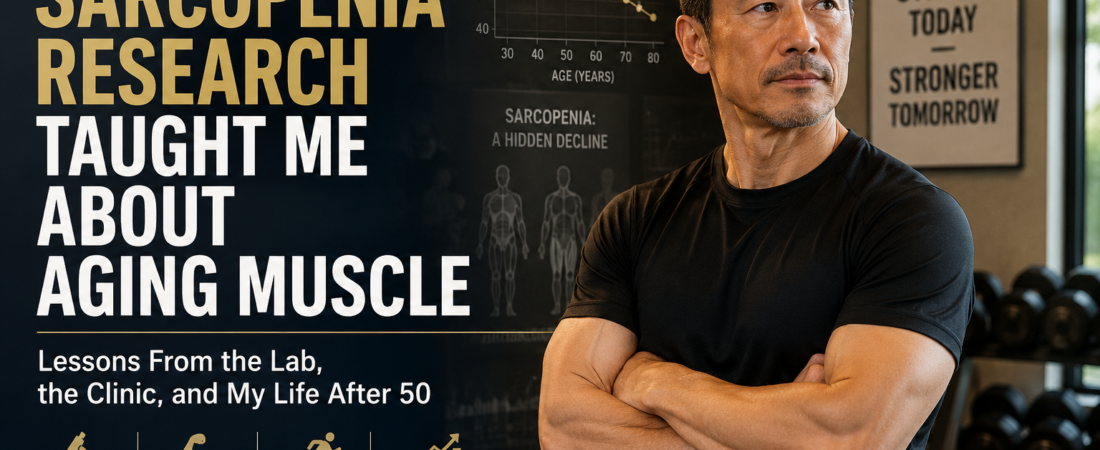
My interest in aging muscle did not begin in a gym. It began in the operating room.
As a thoracic surgeon and researcher, I have spent years studying how muscle mass and body composition affect patients with lung cancer. Sarcopenia — the loss of skeletal muscle mass and function — was not an abstract concept for me. I saw its clinical consequences in real patients.
Over time, that research changed the way I think about aging itself.
When I turned 50, the question became personal:
How much muscle can we preserve, how much strength can we maintain, and what kind of muscle do we want to carry into the next decades of life?
Sarcopenia Is More Than Losing Muscle
Sarcopenia is often described as age-related loss of muscle. But clinically, the problem is not just how much muscle a person has.
Strength and physical performance matter too.
Two people can have similar muscle mass and still function very differently. One may remain strong, mobile, and independent. The other may struggle with walking speed, balance, or everyday physical tasks.
This is why I think the discussion after 50 should move beyond simply “preserving muscle.”
We should be thinking about three things:
Muscle quantity.
Muscle strength.
Muscle function.
And increasingly, we also need to think about muscle quality — what that muscle is actually like beneath the surface.
What I Learned From Following Patients After Lung Cancer Surgery
In one of our studies, we followed 443 patients with early-stage non-small cell lung cancer before surgery and again about one year later.
Among patients who did not have sarcopenia before surgery, a substantial number developed it during follow-up. Lower BMI was independently associated with postoperative sarcopenia.
That finding stayed with me.
It does not mean that being thin causes sarcopenia, and these were patients undergoing cancer surgery, not healthy adults. But it showed me how much can change beneath a seemingly simple number such as body weight.
A person can lose muscle without looking dramatically different. Weight alone may not reveal what is happening to skeletal muscle over time.
We also found that sarcopenia before or after surgery was associated with poorer long-term outcomes.
For me, the lesson was not simply that muscle matters in cancer.
It was that muscle deserves to be followed over time — not only measured once.
Muscle Is Not Just a Motor
Skeletal muscle does much more than move our bodies.
It is a metabolically active tissue and also functions as an endocrine organ. Muscle communicates with other parts of the body through signaling molecules often called myokines.
Research has explored how these signals may interact with metabolism, inflammation, immune function, and even the biological environment surrounding cancer.
For example, molecules such as myostatin and IL-15 have been studied for their roles in muscle regulation and immune signaling. The science is still developing, and these pathways should not be interpreted as proof that having more muscle directly prevents disease.
But the broader message is important:
Muscle is not simply tissue that helps us lift, walk, or climb stairs. It is an active part of human physiology.
That changed the way I looked at muscle loss. Losing muscle with age may mean more than becoming weaker or looking thinner. It may reflect a broader change in how the body functions.
Why This Became Personal at 50
In my late 40s, I was still training in kickboxing and spending time in serious gyms with professional fighters and champions.
I felt physically capable. I had cardiovascular fitness, training experience, and confidence in what my body could do.
Then I suffered a muscle injury during training.
It was a simple reminder that being fit does not make us immune to age-related changes in muscle.
Around the same time, I had also spent several years deliberately reducing my body weight. By the time I approached 50, I began to question whether becoming lighter was really the right goal for the next stage of my life.
So I changed direction.
Over the following year, I gradually increased my body weight while paying attention to strength, training, protein intake, aerobic fitness, recovery, and body composition.
I was not trying to become bigger for appearance.
I was trying to build a body that could keep working, moving, and taking on challenges for decades.
At 50, my research on sarcopenia stopped being only academic. I began applying the same questions to myself.
What I Track Now
I still track body weight, but I no longer treat it as the main target.
I pay attention to strength, training consistency, waist circumference, aerobic fitness, recovery, sleep, and how my body actually performs in daily life.
I also want to know how these things change over time.
That is why I have started keeping a long-term record of my own body after 50 — not because I believe one person can prove what works for everyone, but because longitudinal data can reveal patterns that a single measurement cannot.
For me, the goal is not anti-aging in the sense of trying to look permanently young.
The goal is to preserve the capacity to work, move, think, recover, and keep taking on meaningful challenges as long as possible.
Sarcopenia research taught me that muscle loss can happen quietly.
Turning 50 taught me that the right time to pay attention is before the decline becomes obvious.
Don’t wait until you look frail to think about muscle.
This article is part of my Doctor After 50 project — a long-term exploration of strength, muscle quality, body composition, and healthy aging.