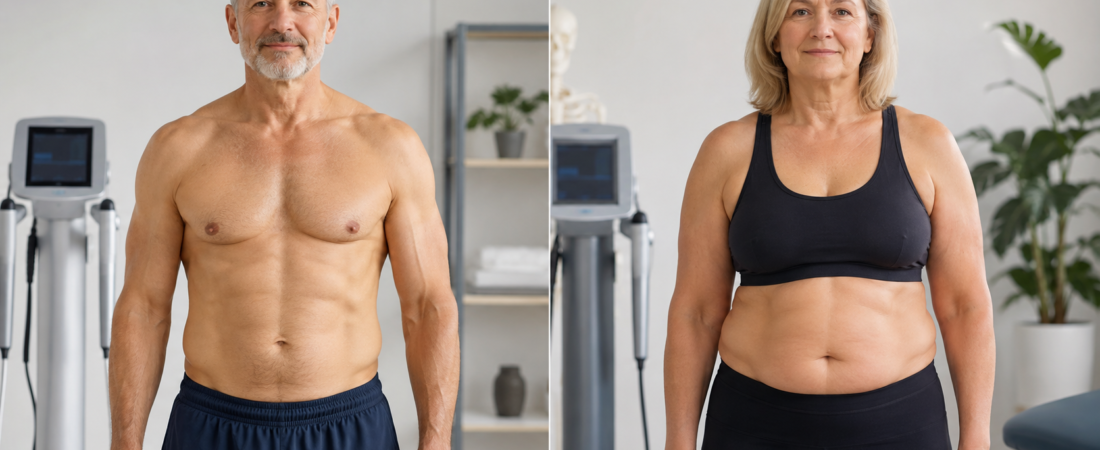
For decades, BMI has been used as a simple way to judge whether a person’s body weight is healthy. It is useful, but it tells only part of the story.
After 50, that limitation becomes increasingly important.
Two people can have exactly the same BMI and very different bodies. One may carry more skeletal muscle and less fat. The other may have less muscle, more visceral fat, or poorer muscle quality. The number on the scale may look similar, while the biology underneath is very different.
At 50, I have stopped asking only, “Is my weight low enough?”
I am much more interested in a different question:
What is my body made of, and what can it still do?
BMI Tells You Something — But Not Enough
BMI is calculated from only two numbers: height and weight. It is useful for describing populations and for identifying broad weight-related health risks. But it cannot tell us what that weight is made of.
It does not distinguish skeletal muscle from body fat. It does not show where fat is stored. And it cannot tell us whether the muscle we have is strong, functional, or infiltrated with fat.
This matters more as we get older. With aging, body weight can remain relatively stable even while muscle mass decreases and fat mass increases. A person may therefore have a “normal” BMI while important changes are taking place beneath the surface.
For me, BMI is still useful. I just no longer treat it as the final answer.
Two People Can Have the Same BMI and Very Different Bodies
Imagine two people who are the same height and have the same BMI.
One has relatively more skeletal muscle and less body fat. The other has less muscle and more fat, including fat stored around the abdominal organs or within and around skeletal muscle.
On paper, their BMI may be identical.
But their strength, metabolic health, physical function, and long-term risks may be very different.
This is one reason I think body composition becomes increasingly important after 50. The question is not simply how much we weigh, but how much of that weight is muscle, how much is fat, where that fat is located, and how well the muscle actually functions.
A “normal” BMI can therefore be reassuring, but it can also hide important differences.
Muscle Mass Is Only Part of the Story
Muscle mass matters, but it is not the whole story.
Muscle also has quality. Two people may have a similar amount of muscle, yet the muscle itself may differ in composition and function.
One important concept is myosteatosis — the accumulation of fat within and around skeletal muscle. This can be associated with poorer muscle quality and lower physical performance, even when overall body size does not look unusual.
In other words, simply having “enough muscle” on a scan or on the scale does not necessarily mean that the muscle is functioning optimally.
After 50, I think the more useful questions are:
How much muscle do I have?
How strong is it?
How well does it function?
And what is happening inside that muscle over time?
What My Sarcopenia Research Taught Me
My interest in muscle did not begin with fitness. It began in cancer surgery.
In one study I supervised, we followed 443 patients with early-stage non-small cell lung cancer before surgery and again about one year later. Even among patients who did not have sarcopenia before surgery, many developed it during follow-up. Lower BMI was independently associated with postoperative sarcopenia.
In another study, we evaluated psoas muscle volume in patients with early-stage lung cancer. Lower muscle volume was associated with worse outcomes, reinforcing the idea that skeletal muscle is not simply passive tissue.
These studies were conducted in patients with cancer, so their findings should not be directly applied to healthy adults. But they changed the way I think about aging.
A lower body weight is not automatically a better body. BMI can miss important changes in body composition, and muscle itself may matter far beyond appearance.
Skeletal muscle is metabolically and biologically active. Research has increasingly examined how muscle-derived signals, including myokines, may interact with metabolism, inflammation, immune function, and disease. Much remains to be understood, but muscle is clearly more than something we use simply to move.
At 50, that research has become personal.
What I Pay Attention to at 50
At 50, I pay less attention to one number and more attention to the pattern.
I look at body weight, but I also pay attention to strength, waist circumference, training consistency, aerobic fitness, recovery, sleep, and how my body actually performs.
I am not trying to become as light as possible, and I am not trying to build the largest muscles possible.
My goal is simpler:
to build and maintain a body that is strong, mobile, resilient, and capable of supporting meaningful work for decades.
That means watching not only muscle quantity, but also muscle quality and physical function.
BMI can still be useful. But after 50, I think it should be treated as a starting point, not the conclusion.
I no longer ask only, “What do I weigh?”
I ask, “What is my body made of, and what can it still do?”
This is part of my Doctor After 50 project — an ongoing exploration of strength, muscle quality, body composition, and healthy aging.
Not Sure What to Work on First After 50?
Your weight or BMI alone cannot tell you what your body needs next. Take the free After 50 Body Assessment to see your Body Code, four-domain score, priority area, and first pathway.
Take the Free Body Assessment →https://doctorafter50.com/body-assessment/