If you haven’t exercised in years, starting strength training after 50 can feel surprisingly complicated. Should you join a gym, buy weights, or lose some weight first? And how much effort is enough without doing too much?
A practical starting point is two short sessions a week, using movements you can control. Your first task is to find an exercise level you can repeat, recover from, and gradually build on.
Start with the body you have today
An exercise that was easy at 30 may feel different at 50. That does not tell you what you can eventually achieve, but it does help you choose where to begin.
Think about everyday movements. Can you stand up from a chair without using your hands? Carry groceries comfortably? Walk up stairs without needing a long recovery? These observations are useful starting information, although they do not diagnose a medical condition.
Also consider what limits you. Difficulty standing from a chair, knee pain, breathlessness, and exhaustion after poor sleep require different responses. Simply adding more repetitions will not address every problem.
If you have chest discomfort, unexplained breathlessness, dizziness, or a health condition that may affect exercise, get medical advice before increasing the challenge. Persistent joint pain or difficulty with basic movements may warrant help from a physiotherapist or qualified exercise professional.
Begin with two sessions a week
Public activity guidelines recommend muscle-strengthening activities on at least two days a week, covering the major muscle groups. For someone returning after a long break, that provides a useful weekly structure.
Choose two days with a rest day between them, such as Monday and Thursday. Keep the first sessions short enough to fit your schedule and leave time to recover.
The routine below is an introductory example for a generally healthy beginner. It is a way to become familiar with several movements, rather than a complete program for every muscle group or medical situation.
A simple first session
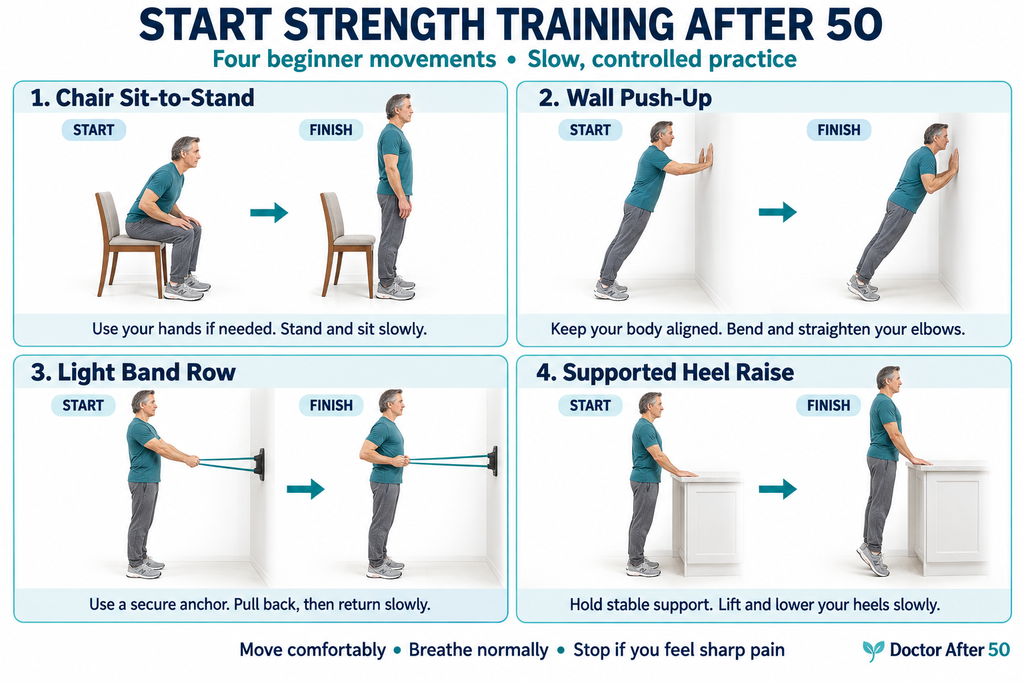
Warm up with a few minutes of comfortable walking and gentle movements. Use a stable chair and secure equipment, and give yourself space to move.
1. Chair sit-to-stand
Sit on a firm chair with your feet on the floor. Lean forward slightly, stand up, and sit down under control. Use your hands if needed. Begin with about five to eight comfortable repetitions.
If this is difficult, choose a higher seat or use support. If it becomes easy, work toward standing without your hands before adding weight.
This image shows the five-times chair stand test. For the beginner exercise described here, move slowly, use your hands if needed, and do not time yourself.
2. Wall push-up
Place your hands against a wall at about chest height. Bend your elbows to bring your body toward the wall, then push back. Keep your body aligned and begin with about five to eight controlled repetitions.
Standing closer to the wall usually makes the exercise easier. Choose a position that allows comfortable movement without shoulder or wrist pain.
3. Light resistance-band row
Using a band secured according to its manufacturer’s instructions, pull your elbows back toward your sides, then return slowly. Start with light resistance and about eight comfortable repetitions.
Check the band and anchor before use. If you are unfamiliar with the setup, ask someone qualified to demonstrate it.
4. Supported heel raise
Hold a stable counter or chair for balance. Slowly rise onto your toes and lower your heels. Begin with about eight controlled repetitions, keeping your support within reach.
For your first session, one set of each movement may be enough. Rest between exercises until you feel ready to continue. The repetition counts are starting examples, not targets you must reach.
How hard should it feel?
At first, choose a level that lets you learn the movement while breathing normally. Finish the set before your technique starts to deteriorate.
As you become comfortable, the exercise should involve meaningful muscular effort. A movement that stays effortless indefinitely will eventually need more resistance or a harder variation to keep developing strength.
Muscle effort and pain are different signals. Stop an exercise that causes sharp pain. Stop the session and seek medical attention for chest pain, faintness, or unusual severe breathlessness.
Soreness is not a score. Being so sore that you cannot manage your usual activities can make it harder to establish a routine.
Progress one thing at a time
After several sessions, review how the exercises feel during training and how you recover afterward.
If a movement is comfortable and controlled, add a small number of repetitions. Later, you might add another set, use a slightly stronger band, or choose a harder variation. Avoid increasing all of these at once.
For example, a chair sit-to-stand might progress from six repetitions with hand support to eight without it. A wall push-up might progress to a secure, elevated surface once you can control the easier version.
Write down the exercise, the repetitions, and how it felt. This gives you a clearer record than relying on memory or judging each session by how tired you became.
Keep walking, too
Walking and strength training serve different purposes. Walking helps you build aerobic activity into your day; resistance exercise gives your muscles a more direct strength challenge.
If you have been inactive, start with a manageable amount of walking and increase gradually. The general recommendation of 150 minutes of moderate aerobic activity a week is a goal to work toward, rather than a requirement for your first week.
Your schedule should allow both activity and recovery. If every session leaves you exhausted, reduce the amount and reassess the exercise level.
Measure progress beyond body weight
The scale may change little when you begin. You can still track whether standing from a chair feels easier, whether you need less support, or whether you can perform more controlled repetitions at the same resistance.
These are practical signs that your training capacity is changing. They can help you decide when to progress without making weight loss the only measure of success.
Choose your starting priority
Strength is one part of your physical foundation. Waist size, activity capacity, sleep, and recovery also influence what deserves attention first.
The free After 50 Body Assessment helps you review four areas: Body & Waist, Strength & Function, Engine & Activity, and Recovery & Load. You receive a Body Code and a suggested starting pathway to help organize your next steps. It is an educational tool, not a medical diagnosis or exercise clearance.
Take the Free After 50 Body Assessment →
Build your next 8–12 weeks
Once you understand your starting point, you can put strength training into a broader plan.
The 77-page After 50 Body Code Blueprint helps you organize strength training, cardio, nutrition, and recovery around your Body Code and choose a starting priority for the next 8–12 weeks.
Explore the Blueprint — $19.99 →